


×
 |
[Photo: Tatiana Gorilovsky]
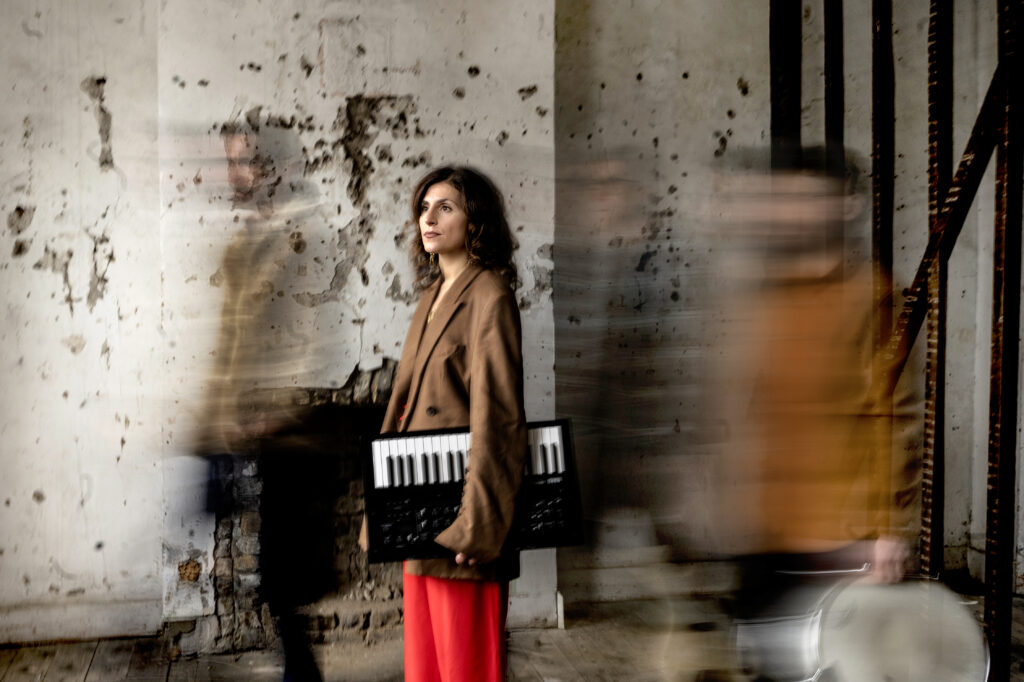
ISQ return with their fifth studio album The Silence Is Deafening, released on 23 October 2026, following eight years since their previous album.
Led by vocalist and songwriter Irene Serra, the record brings together jazz, alternative pop and electronic textures with a darker, guitar-driven sound. Across the album, Irene explores women’s lives, inheritance, migration, relationships, grief, resilience and the things which can remain unspoken.
Ahead of the album release and ISQ’s launch show at Crazy Coqs on 15 October, ConnectsMusic caught up with Irene about how the record evolved, her mother’s story, the writing behind Faded and Angela, the musical relationship within ISQ, and finally bringing these songs to the stage.
Emily Saunders: You’ve said your songs were a long time in the making over a few years. Do you feel your writing, and what you wanted to communicate through your music, evolved during that time?
Irene Serra: Yes, definitely. I think the years since my last album have probably been some of the most eventful of my life, personally, both good and bad. And on a wider level, so much has happened in the world, politically and socially, that has inevitably influenced the things I care about and want to explore through my music.
During that time, I also wrote a lot. I kept writing as a practice, and I think that helped me evolve technically as a songwriter, but also in terms of the subjects I wanted to tackle.
So yes, I think my writing has evolved quite naturally alongside my own experiences and my changing perspective on the world.
Emily Saunders: As The Silence Is Deafening unfolds, there’s such a strong thread resonating of women’s lives, inheritance, resilience, and the things which can remain unspoken. How did these different stories start to connect for you as one complete body of work?
Irene Serra: I wrote a lot over these past few years, and when it came time to gather my thoughts into an album, the pieces that resonated most with me—especially lyrically—were the ones about women and their lives and their experiences. They were simply the tunes I loved playing and singing the most, and then I realized, “Oh, wow—look at this common thread.” It emerged quite naturally, really.
Emily Saunders: Your mother’s experiences clearly sit very close to the heart of your music on this album, particularly around migration, family, expectations placed on women, and the complex connection between mothers and daughters. Has writing your songs had an impact on how you feel about your mother’s story, or perhaps your own relationship with it?
Irene Serra: Yes, definitely. Unfortunately, my mother passed away in 2018, and processing that grief has been a huge part of my life ever since. Inevitably, that has also found its way into my music, because I thought, and still think, about her a great deal.
When she died, I was at a stage in my life where I was roughly the same age she was when she moved to Denmark, and that made me reflect on her experiences in a completely different way. I looked back at our relationship, not just as her daughter, but as a woman in my own right, trying to understand her perspective.
We were actually very similar in many ways, but our upbringings were fundamentally different. When I was younger, I thought those differences made us very different people, but I’ve come to realise that they simply gave us different outlooks on life. And actually, had I grown up in her environment, at that particular time, I probably would have seen the world in much the same way she did.
My mother was from southern Sicily, and after she passed away, I found myself going back there quite a lot. My father is Sardinian, and growing up we visited Sardinia much more frequently, so I felt this real desire to reconnect with my mother’s side of the family and the island she came from.
Sicily is such an extraordinary place, with an incredibly rich and complex history. It’s been a crossroads between Europe and North Africa for centuries, and being there made me think a lot about migration, both historically and in the context of what’s happening today.
My mother came from the very south of Sicily, so geographically incredibly close to North Africa. And I remember thinking that, really, it’s just a geographical technicality that she was born on one side of the Mediterranean rather than the other. That it could so easily have been my mother putting her children onto a tiny, overcrowded dinghy, risking everything to cross the sea in the hope of a better life.
That thought has stayed with me ever since. Of course, growing up with Sicilian roots, migration and the tragedies unfolding in the Mediterranean have never felt particularly distant. But reconnecting with my mother’s story made it all feel even more personal, especially against the backdrop of the increasingly negative rhetoric surrounding migration.
So I think writing these songs has helped me understand my mother, her choices and her experiences with a different perspective, and inevitably all of those reflections have found their way into the music.
Emily Saunders: Within your album, the song Faded poignantly explores the almost imperceptible process of a person gradually losing and re-discovering themselves within a controlling relationship. Musically and lyrically, how did you choose to approach telling this sensitive narrative?
Irene Serra: Well, it’s definitely something I’ve experienced myself, and I think what was important to me was not to make the narrative too obvious, because that’s often exactly how a controlling relationship unfolds.
I wanted to approach it almost like any other love story, starting with that initial hope and infatuation, when you want to see the best in someone and love them to the best of your ability. And then, little by little, that person starts chipping away at the very things they may have fallen in love with you for in the first place.
It’s such a gradual process. It’s not as though one day everything is wonderful and the next day the person suddenly becomes objectively terrible. The dynamics shift almost imperceptibly, until perhaps three years down the line you realise that the relationship has completely changed, and so have you. But by then, you’ve become accustomed to it.
And there’s something incredibly exhausting about that experience. You’re constantly trying to make the other person happy, hoping things will improve, questioning yourself, overthinking everything, particularly when there’s gaslighting involved.
You can end up pouring so much energy into the relationship that you barely recognise the person you’ve become. The joy that was there at the beginning has gradually been replaced by something else.
So lyrically, I wanted to reflect that subtlety rather than describe anything too extreme or obvious. And musically, I wanted the song to unfold in much the same way. There’s repetition in the chord progressions of the verses and choruses, but also shifts in groove, rhythm and movement throughout the piece, which I wanted to mirror those gradual changes in the dynamics of the relationship.
I wanted both the music and the lyrics to tell that story together, in a way that feels gradual, almost imperceptible, until you reach that final moment of release.
Emily Saunders: Your latest single Angela steps into a different perspective, through someone outside of a relationship who can see that something is wrong but may not know how to help. Was it important for you to leave the ending unresolved?
Irene Serra: Yes, absolutely. In many ways, Angela is an expansion of the themes I explored in Faded, but this time from the perspective of a neighbour looking in, gradually noticing the subtle signs of domestic abuse but not really knowing how to approach the situation, whether to intervene or how to help.
The song was partly inspired by the UK’s Ask for Angela campaign, which offers people who feel unsafe or threatened a discreet way of asking for help in participating venues.
And yes, leaving the ending unresolved was very much a conscious decision, for a number of reasons, both artistically and lyrically. I wanted to leave it to the listener to imagine their own ending, depending, I suppose, on how hopeful or pessimistic they might be!
Towards the end of the song, the neighbour walks past Angela’s house one day and notices that it’s up for sale, with her post left outside waiting to be collected. And that’s all we know. Has Angela managed to escape the relationship and start a new life somewhere else? Or has something far more sinister happened? Has her partner killed her?
The tragic reality is that leaving an abusive partner can be one of the most dangerous moments in an abusive relationship, when the risk of serious violence or even murder can be particularly high. It’s a rather macabre thought, but unfortunately it’s a very real one.
So I wanted the ending to reflect that uncertainty, while also giving the listener the freedom to imagine what might have happened to Angela. I think there’s something quite powerful about leaving a story open-ended, particularly when it’s dealing with something so sensitive. Rather than offering a neat resolution, I wanted people to sit with that uncertainty and perhaps reflect on what they might have done in the neighbour’s position.
Emily Saunders: We love the development in the ISQ sound on The Silence Is Deafening, still sitting in the jazz area with a darker, more guitar-driven and cinematic feel. Was that a conscious musical direction, or did the sound evolve naturally from the subjects you were writing about?
Irene Serra: Yes, I love it too! It’s funny because the first three albums were all piano-based, and that’s actually how I tend to write. Most things start at the piano for me, so it always seemed like the natural choice.
But between the third and fourth albums, I was going through quite a few changes, both personally and musically, and I started feeling that I wanted a more open soundscape. The music was evolving anyway, and I felt that replacing the piano with guitar might give everything a little more space, allowing the music to breathe differently. It was definitely something I wanted to explore.
At the time, I was already playing with an excellent guitarist, Luca Boscagin, who’s also a very good friend and colleague of mine, so he was naturally the first person I thought of when I decided to make that change.
And honestly, from the very first rehearsal, it just felt right! Even the older material, which had originally been arranged around the piano, sounded beautiful with guitar. But particularly with the new songs, everything just seemed to fall into place. I remember thinking that perhaps this was the sound I’d been looking for all along.
And with this album, that musical relationship developed even further. When we got into the rehearsal studio with the new material, things just opened up. Luca is an incredibly creative musician, and he was just as enthusiastic about experimenting with different sounds, guitar pedals and effects, and bringing new textures into the music. He came up with so many wonderful ideas, and it was really exciting to explore those possibilities together.
So although the decision to move from piano to guitar was initially quite conscious, the way the sound has developed since then has been incredibly organic. I think it’s really been a natural evolution of the live band and the musical direction I’ve been moving towards.
Emily Saunders: ISQ has a wonderful established musical relationship between you, Richard Sadler, Chris Nickolls and Luca Boscagin. When the material is this personal, how important is the trust between the four of you?
Irene Serra: I’m incredibly lucky to play with these guys. Besides being wonderful musicians and colleagues, they’ve also become very good friends over the years, and I think that makes such a difference.
The material on this album is incredibly personal and, at times, quite raw, and I think it says a lot about how much I trust them, both musically and personally, that I never had any second thoughts about bringing these songs to them and opening myself up in that way.
When we get into the rehearsal room, I know I can give them that material and allow them the freedom to contribute creatively, because I trust that they’ll always bring something wonderful to it, while also being sensitive to what the songs are trying to communicate.
There’s a real sense of care and understanding, and I think that’s incredibly important when you’re dealing with such personal subjects.
And I think that relationship really comes across on stage. We have a fantastic time playing together, and there’s such a lovely dynamic between us. We can go from these really powerful, almost rock-like moments, with huge energy and intensity, to something incredibly soft, gentle and intimate, which some of the songs really call for.
That ability to move between those extremes so naturally comes from knowing and trusting each other so well, both as musicians and as people.
They’re wonderful guys, and I feel very, very lucky to have them as musical collaborators and friends.
Emily Saunders: The album closes with She Walks Through Fire, another stunning title – bringing together ideas around female resilience, intergenerational connection, ageing, environmental responsibility, and voices that can too easily be ignored. This multi-layered, powerful and emotive close must have been a clear choice for you. How do you feel about the medium of song, lyric and music being able to portray what you feel about poignant, potent subjects close to your heart?
Irene Serra: She Walks Through Fire was always the obvious choice to close the album, especially because it has this quite epic ending. I think I must have layered about five or six different vocal harmonies on that outro alone!
It’s a song for all my witches out there!
At its heart, it’s about our relationship with Mother Nature, the idea of motherhood, nurturing and caring, but also about how women have historically been perceived and treated, particularly those who didn’t conform to society’s expectations.
I find the whole idea of witches fascinating. These were often women who lived independently, had a deep understanding of nature and its healing properties, and existed outside the traditional structures of society. And for that, they were feared, persecuted and sometimes even burned at the stake. Yet there’s something incredibly healthy and intuitive about living in harmony with nature, something I think we’ve lost touch with and desperately need to rediscover.
And when I look at the world today, with some very dangerous men occupying positions of enormous political power, I can’t help feeling that we need much more of that feminine energy to restore some balance. Not just between men and women, but in our relationship with the planet, with each other, and with the way we organise our societies. Almost like a collective reset!
I think that intuitive, nurturing, independent feminine energy has been suppressed and penalised for centuries, sometimes literally to the point of death, within patriarchal structures. And our increasingly capitalist way of life has only taken us further away from that connection with nature and with one another. Frankly, I don’t think it’s working for us, and I’m not sure it ever really did!
So She Walks Through Fire is almost a call to reclaim that energy, to celebrate it rather than fear it. And I love that music allows me to explore these ideas not just through lyrics, but through sound, texture and emotion. That huge, layered vocal ending felt like the perfect way to express it, almost like a gathering of voices, growing stronger together.
Emily Saunders: For everyone reading – your launch of your long-awaited, heartfelt and beautifully delivered album is at Crazy Coqs on 15 October, just ahead of its release on 23 October. What are you most looking forward to about finally putting the whole body of work in front of an audience?
Irene Serra: I’m really looking forward to the album launch this Thursday! There are so many different stages involved in writing, recording and releasing an album, and I genuinely love all of them equally. But there’s something incredibly humbling about finally sharing music that you’ve spent so much time creating, rehearsing and developing in what is essentially a very private environment, especially when the writing is as personal and intimate as it is on this album.
I think performing the songs live is almost like the final stage of that journey, the moment when you give the music, the lyrics and all those thoughts and emotions away. Until then, they’ve been very much yours, but suddenly you’re sharing them with an audience, and you have absolutely no idea how they’re going to land or what people will take away from them.
And I think that’s quite a beautiful thing, really. Particularly with this album, singing some of these words live can be quite emotionally powerful for me, so I try not to have any expectations about how other people will receive them.
In a way, I see the live performance as completing the circle. You start with an idea, something very personal, you turn it into a song, develop it with the musicians, record it, and then finally you offer it to an audience.
And at that point, it’s no longer just yours. It’s theirs to keep, to interpret however they want, to connect with, or perhaps not even think about again! And that’s absolutely fine too.
I suppose that’s what I’m most looking forward to: finally letting these songs go and seeing them take on a life of their own.
Photo: Tatiana Gorilovsky