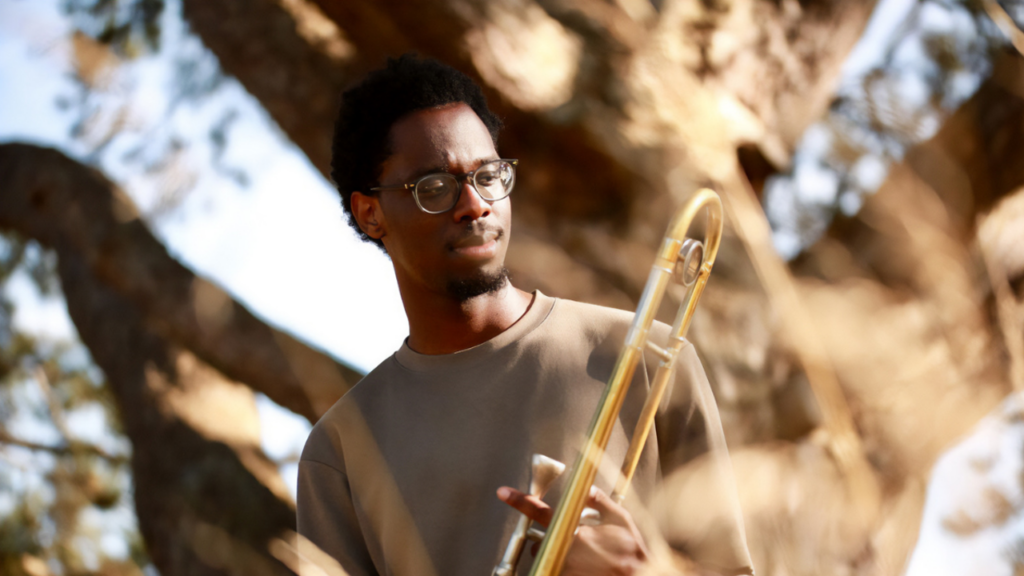
Trombonist, composer and bandleader Christ-Stéphane Boizi releases his debut album As The Spirit Leads on 2 October 2026 via Banger Factory Records.
Rooted in his gospel upbringing and faith, the album brings together acoustic jazz, hard bop, contemporary New York influence and church music, with family and community running throughout the record.
Ahead of the release, ConnectsMusic caught up with Christ-Stéphane to talk about what’s important to him, the role of faith in his writing, the story behind Raymond, Tomorrow’s Warriors, community, and the musical principles he wants to carry forward through his career.
If you focus on your own journey, you’ll enjoy the process even more.
Emily Saunders: As your debut album ‘As The Spirit Leads’ is rooted in your gospel upbringing and faith, how do those experiences shape the way you compose and lead your band?
Christ-Stéphane Boizi: Well, I think the experiences I have had throughout my life feed right into the music, both in how I compose and lead the band. From a compositional perspective, Gospel Music is what I grew up on and have had in my ears from a very early age, so it felt only right to ground my music in it. My first interaction with music was singing hymns in primary school, and I am super grateful for that. Thinking of my music as ‘singable’ has been a very important part of my composition process. It must be as singable as it is danceable, because I believe the best music has that effect. As a Christian, all the music on the album was written from an aspect of ‘letting go and letting God take the lead’; hence the title ‘As The Spirit Leads,’ the Spirit in question being the Holy Spirit. The process of removing my own ‘ego’ from my music came naturally. Growing up, I was taught that whatever I do should give glory to God. So, when it came to writing music, I knew that was the music’s ultimate purpose, above everything else. This music serves a higher purpose: giving God glory. In that same vein, it’s how I choose to lead a band. ‘As The Spirit Leads’ serves as a reminder to get out of your own way and do as the moment inspires you to do so. In this music, there’s often an urge to direct exactly how moments should unfold, and I believe the best moments happen when you stay in the moment.
Emily Saunders: Your second single from the album ‘Raymond’ is a tribute to your grandfather, it would be lovely to hear about his love of Art Blakey’s music and how this might have also influenced your composing and playing?
Christ-Stéphane Boizi: My Grandad’s love of Jazz came about when, as a young person, a family friend introduced him to the music of Louis Armstrong. He took a liking to the music, and the family friend came back week after week to show my grandfather more. As his interest deepened, he eventually found out about Art Blakey and the rest of the Hard-Bop canon. I found out my grandfather liked Art Blakey because he specifically asked for him. We watched a live gig by Art Blakey and the Jazz Messengers, with the frontline of trumpeter Lee Morgan, tenor saxophonist Wayne Shorter, and trombonist Curtis Fuller, and I saw a grin on his face as we checked it out. It was a great sight. After spending a couple of years writing, I realised most of my compositions were based on Biblical terms and imagery, and I wanted to try something different. Mark Kavuma’s writing greatly inspires me; the members of his band inspire a lot of his tunes. The tunes aren’t just dedicated to the band member in question; Mark does a great job capturing the band member’s character and creating an archetype of that person. I wanted to do something similar with Raymond. I decided to capture the essence of my Grandad, using all the experiences I had with him and the stories my mum and aunties would tell me to mould ‘Raymond’ in this musical context. I wanted to bring across some of the qualities I have always admired in my grandfather: his quiet demeanour, his swagger, and how put together he always was. He was quite pleased with his musical depiction when he heard the record. I was just as happy as he was.
Emily Saunders: Is there a sense of your grandfather’s character and personality that you’ve intended to portray within your composition ‘Raymond’. Were there specific musical motifs or compositional ways which enabled you to translate a loved person’s personality and memory to be portrayed in music?
Christ-Stéphane Boizi: My Grandad has always been a man of few words, and so I decided to write a punchy melody. With Art Blakey as the musical inspiration behind this song, I wanted to write something up-tempo and swinging. I had been meaning to write something swinging, and I’d been checking out a lot of Cedar Walton too during that time. The different feels throughout the entire tune, I feel, captures my grandfather’s swagger.
All my different musical inspirations come together to form my overall musical identity.
Emily Saunders: Your album ‘As The Spirit Leads’ brings together acoustic jazz, New York influence and the power and simplicity of church music. How did you find balancing combining those musical worlds?
Christ-Stéphane Boizi: Gospel and Church Music are very much ‘home’ for me. It’s what I’ve grown up with, and it was my entry into music through singing hymns at school. Jazz Music and Black American music came at a time when I was still very young, and it spoke to me immediately. I spent a long time just soaking up everything and all types of jazz music. I eventually found Hard Bop and Post-Bop Jazz in my first year of university, and that’s when I found my musical thing. A bit later, I learned about New York contemporary musicians and found a sound I also resonated with. Musicians like Giveton Gelin, Joel Ross, and Immanuel Wilkins, for example, were creating a sound world that I recognised as rooted in the Church but sounding very different. I recognised that same sentiment in the Art Blakey albums that I had checked out when I was younger. I don’t really see it as balancing; rather, all my different musical inspirations come together to form my overall musical identity.
I value their friendship, their belief in me and the music we’re creating together and who they are as individuals.
Emily Saunders: Community seems central to your record, in the themes and the musicians around you – what do you value most in the players you choose to create music with?
Christ-Stéphane Boizi: As I said before, I count myself real lucky to be part of an amazing and incredibly supportive community of musicians, mentors, teachers, and elders, so it only feels right to highlight that fact. Music is meant to be played with others; Life is meant to be done with others. It’s a very important part of the human experience. I have been blessed with the most amazing friends, and I have the deepest pleasure of making music with them. I got to know each of them as people and as friends first, so having them as band members is a real bonus. They have all brought so much of themselves to the music and really bought into it. It’s been a pleasure to grow alongside each of them. In short, I value their friendship, their belief in me and the music we’re creating together and who they are as individuals.
Emily Saunders: You’re a Tomorrow’s Warriors alumnus, and you’re now touring through the Warriors Rise initiative. How important was Tomorrow’s Warriors as an initial pathway for your work as an artist and bandleader? And how valuable are Tomorrow’s Warriors as an impactful, dynamic, and supportive organisation today?
Christ-Stéphane Boizi: It goes without saying that Tomorrow’s Warriors has been incredibly pivotal to this band. We got our first gig through Tomorrow’s Warriors, and for the first couple of years, many of our gigs came through them. Those gigs let us experiment and play live. It takes a lot for these different places and people to trust they’ll get a return on investment when booking younger, up-and-coming bands. Still, Warriors let us not have to think about the pressure of ticket sales and instead approach the bandstand from a place of complete creativity, while getting used to the added pressure that comes with it. If you look around the British Jazz Scene, throughout the history of Jazz in this country, you can see a Warrior everywhere, which tells you all you need to know. TW’s impact will stand the test of time because everyone out there carries the organisation’s legacy. It’s not something that ever leaves once you become an alumnus; it’s stitched onto you. The opportunity to tour this music is a testament to their commitment to and belief in the next generation of jazz musicians, and I am grateful for their backing; it means the world.
Emily Saunders: You’re emerging at a point when there’s a very strong new generation of British jazz musicians coming through. Do you feel part of a particular movement or community, or are you more focused on carving out your own voice?
Christ-Stéphane Boizi: I feel very much tied to my generation; everyone is creating such amazing and super diverse music. It’s a really great time. I am just super happy to witness all the amazing work that’s going on. Placing myself in a particular camp isn’t helpful; there’s no need to draw lines dividing ourselves. We’re all so young and making this thing called music happen; I want to enjoy it all.
Emily Saunders: Now that ‘As The Spirit Leads’ is being released into the world, what would you love it to say about who you are as an artist at this point in your life?
Christ-Stéphane Boizi: Listeners are meeting me at a point in my life where I am laying the foundation for what I want my artistry to stand for and represent. For me, ‘As The Spirit Leads’ is far more than just an album; it not only serves as a documentation of where the band is at but, perhaps more importantly, I want everything that ‘As The Spirit Leads’ is rooted in to be the guiding principles that I stay committed to throughout my career. As I grow older and continue to write more music and more bodies of work and broaden my influences, I hope that the commitment I have to my faith, family, community and this music remains at the heart of my artistry.
Emily Saunders: Finally, for younger musicians in the ConnectsMusic community who are developing their own sound, what would you say about balancing, trusting your influences, with your own instincts, and finding a creative process that feels most important to you?
Christ-Stéphane Boizi: Figure out what you like, who you like, why you like it, and that will guide you. Tradition, whatever it may be, is a roadmap that shows you what came before and what worked. You should investigate what makes what they do sound good. Follow that roadmap. Last thing, run your own race. There’s a lot of comparison in music but comparing yourself takes away from the joy music brings. If you focus on your own journey, you’ll enjoy the process even more.
CHRIST-STÉPHANE BOIZI
Raymond – out now
As The Spirit Leads – released 2 October 2026
Banger Factory Records