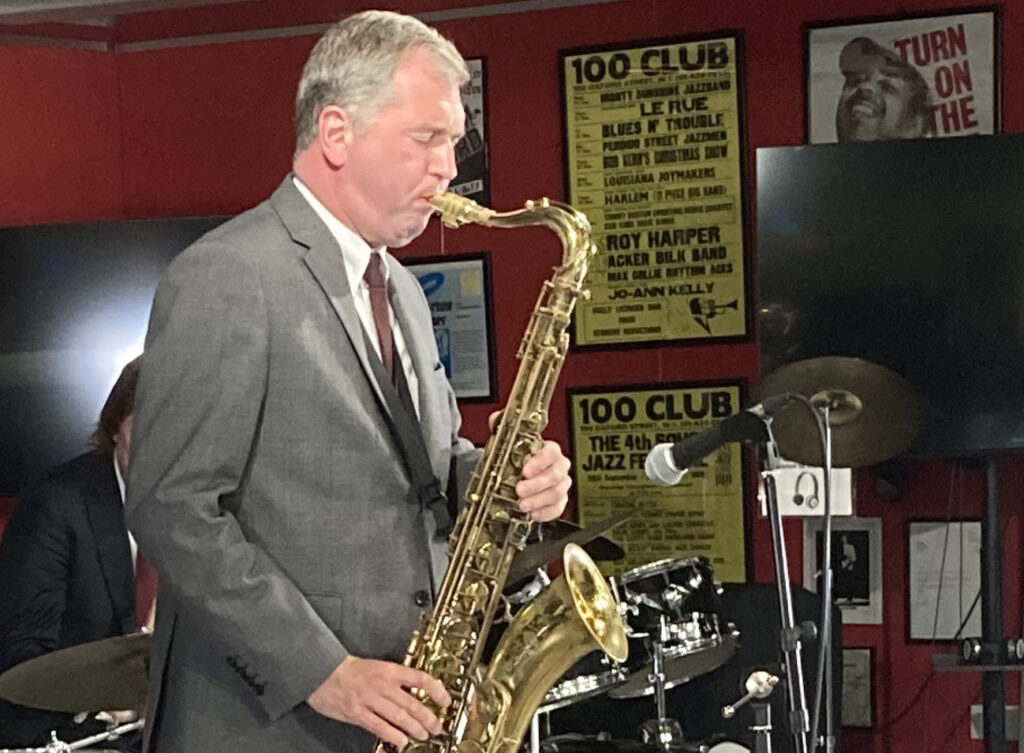
The Jazz Centre UK marked its 10th anniversary with a sold-out afternoon concert from the Simon Spillett Big Band at the Beecroft Art Gallery in Southend-on-Sea.
The event brought together one of British jazz’s most committed heritage organisations with a band built around the music, energy and scale of the British modern jazz tradition.
A full house for TJCUK at 10
The Jazz Centre UK’s 10th anniversary was marked on Saturday 20 June with a sold-out concert led by saxophonist, bandleader, author and historian Simon Spillett. The afternoon took place in the centre’s home at the Beecroft Art Gallery in Southend-on-Sea, where TJCUK has built a year-round programme of concerts, talks, exhibitions, education work and archive activity.
The event had been announced as a special anniversary concert, but by the time the audience gathered it had become a clear celebration of what TJCUK has managed to build across its first decade. A packed room, a large band and a programme rooted in British jazz history made the afternoon feel well suited to the occasion.
For a centre based outside the usual London jazz circuit, the anniversary also showed the strength of TJCUK’s local and national reach. The organisation has spent ten years presenting live music while also preserving records, stories, photographs, instruments and printed material connected to jazz in Britain and beyond.
The concert was also a reminder that archive work and live performance belong together. TJCUK is not a static display of jazz history. Its anniversary was celebrated through sound, players, arrangements and an audience able to hear that history moving in the present tense.
Simon Spillett and the British big band sound
Simon Spillett was a fitting artist to lead the anniversary concert. He is a Patron of The Jazz Centre UK, one of its earliest Trustees, and a musician whose work as a performer and writer is closely connected with the story of British modern jazz.
Spillett is widely known as one of the leading interpreters of Tubby Hayes, the saxophonist whose playing, composing and bandleading helped define a high-energy strand of British jazz in the 1950s and 1960s. Spillett’s big band draws on that lineage, not as pastiche, but as a working band capable of delivering the punch, detail and pace of the music in front of a live audience.
The programme celebrated the music of Tubby Hayes through original arrangements and strong ensemble playing. In the intimate surroundings of TJCUK, the size of the band made an immediate impact. This was not background heritage. It was full-force modern jazz, shaped by musicians who know the language and can carry it without smoothing off the edges.
That balance between scholarship and performance is central to Spillett’s work. He brings historical knowledge, but the point of the band is still sound, momentum and live communication. For an anniversary event at a jazz centre, that combination was exactly right.
The band
The anniversary concert featured a strong big band line-up across trumpets, trombones and saxophones. The trumpets were Nathan Bray, Mark Armstrong, Steve Fishwick and Bruce Adams. The trombones were Mark Nightingale, Andy Flaxman, Ian Bateman and Pete North.
The saxophone section brought together Sammy Mayne, Pete Long, Alex Garnett, Robert Fowler and Alan Barnes. Across the full band, the personnel reflected a deep pool of British jazz experience, with players known for section work, soloing, bandleading and long service to the music.
Large jazz ensembles depend on detail. The excitement comes from the power of the sections, but also from the precision of voicings, entries, dynamics and solo space. That is where a line-up of this calibre earns its keep. It gives the music weight without turning it blunt.
For TJCUK, presenting a band of this size in its own space was also a statement about ambition. The anniversary was not marked with a modest reception or a commemorative speech. It was marked with a room full of musicians and a sold-out audience listening to British jazz at scale.
SIMON SPILLETT BIG BAND LINE-UP
Trumpets: Nathan Bray, Mark Armstrong, Steve Fishwick, Bruce Adams
Trombones: Mark Nightingale, Andy Flaxman, Ian Bateman, Pete North
Saxophones: Sammy Mayne, Pete Long, Alex Garnett, Robert Fowler, Alan Barnes
Led by Simon Spillett
Ten years of concerts, archives and education
The Jazz Centre UK was founded to preserve, promote and celebrate jazz in all its forms. Based in Southend-on-Sea, it has become a cultural resource for audiences, musicians, researchers, volunteers and jazz followers who care about the history of the music and its future life.
Its work includes live concerts, exhibitions, talks, educational activity and community events. It also maintains archives and collections that document jazz history in Britain and beyond. That combination gives the centre a broad role: part venue, part archive, part meeting place, part educational resource.
The 10th anniversary concert drew attention to the people behind that work. TJCUK has been shaped by musicians, trustees, volunteers, supporters, audiences and partners. A centre of this kind does not run on programming alone. It depends on people giving time, knowledge, practical help and steady support over many years.
Matthew Fisher, Chair of The Jazz Centre UK, described the anniversary as a celebration of the centre’s first decade and of the community of musicians, volunteers, supporters and audiences who have helped make the organisation what it is. The sold-out response showed that the community is not an abstract idea. It was there in the room.
A Southend base with a national story
One of TJCUK’s strengths is its position in Southend-on-Sea. It gives the organisation a clear local identity while allowing it to hold a national conversation about jazz heritage. The Beecroft Art Gallery setting has allowed the centre to build an audience around regular activity rather than occasional one-off events.
Jazz history can easily become centralised around a few venues, cities and institutions. TJCUK offers a different model. It makes collections, exhibitions and live performance available through a dedicated centre rooted in its own town, with programming that reaches far beyond the local area.
The anniversary concert captured that role well. Simon Spillett’s big band brought a national strand of British jazz history into a local cultural space, and the audience response confirmed that there is appetite for this work when it is programmed with care.
After the anniversary
The success of the anniversary concert gives TJCUK a strong platform for its next phase. The first decade has established the centre’s identity and built a pattern of activity around performance, heritage and education. The next task is to keep that work visible, accessible and properly supported.
The sold-out Simon Spillett Big Band event showed how much value there is in connecting the archive with live sound. It also showed the continuing pull of British jazz history when presented by musicians with authority and energy.
For audiences who were there, the anniversary was a full-house celebration. For those following TJCUK from elsewhere, it was a useful reminder of the centre’s role: preserving the music, presenting it live and keeping the story of jazz in Britain open to new listeners.
The 10th anniversary has now been marked – the work continues.
FIND OUT MORE
The Jazz Centre UK
Beecroft Art Gallery, Victoria Avenue, Southend-on-Sea, Essex SS2 6EX